
If you want your blog posts to rank higher on Google, understanding keyword frequency, keyword density, keyword difficulty, and keyword proximity is essential. These four SEO concepts directly impact how search engines evaluate your content. In this guide, you’ll learn what each term means, why it matters, and how to use them effectively to improve your website’s visibility and organic traffic.
Keyword Frequency
Keyword frequency refers to the number of times a specific keyword appears in a web page or blog post.
While using your target keyword is important, overusing it can lead to keyword stuffing, which negatively affects SEO and user experience.
Best Practice:
- Use your main keyword naturally.
- Avoid forced repetition.
- Focus on readability and user intent.
Example:
If your blog is 1,000 words, your main keyword should appear naturally around 10–15 times.
Keyword Density
Keyword density is the percentage of times a keyword appears compared to the total number of words on the page.
Formula:
(Keyword Count ÷ Total Words) × 100
Ideal Range:
- 1% to 3% for most blogs
- No fixed rule — Google focuses more on content quality than exact numbers.
What Is Keyword Difficulty?
Keyword difficulty measures how hard it is to rank for a specific keyword on search engines. It depends on:
- Competition level
- Authority of top-ranking websites
- Backlink strength
Why It Matters:
Targeting low to medium difficulty keywords increases your chances of ranking faster, especially for new websites.
Tools to Check Keyword Difficulty:
- Ahrefs
- SEMrush
- Ubersuggest
- Moz
Keyword Proximity
Keyword proximity refers to how close your keywords are placed together in a sentence or paragraph.
Example:
Better:
“Best digital marketing course in Chennai”
Not ideal:
“Best course for students learning digital marketing in Chennai”
Closer keyword placement improves context relevance and SEO performance.
Why These Metrics Matter In SEO
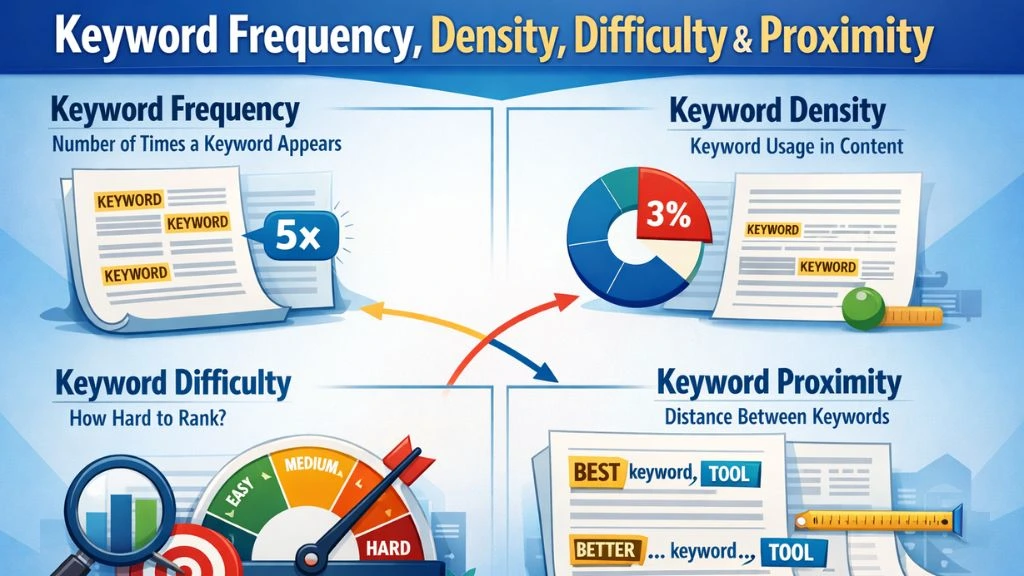
| SEO Factor | Purpose |
| Keyword Frequency | Ensures keyword presence |
| Keyword Density | Measures keyword relevance |
| Keyword Difficulty | Helps select achievable keywords |
| Keyword Proximity | Improves topical clarity |
Together, these factors help search engines understand:
- What your page is about
- How relevant it is to a search query
- Whether it deserves to rank higher
Final Thoughts
Understanding keyword frequency, density, difficulty, and proximity helps you create content that ranks well and delivers real value to users. Focus on quality content first, then optimize naturally using these SEO principles.
Want expert help with SEO?
Check out our SEO Services and grow your online visibility today.
FAQs
1. What is a good keyword density for SEO?
A keyword density between 1% and 3% is generally considered safe and effective.
2.Does Google penalize keyword stuffing?
Yes. Overusing keywords unnaturally can lead to ranking drops or penalties.
3.Is keyword difficulty important for beginners?
Yes. Beginners should target low-difficulty keywords to rank faster and build authority.
4.Does keyword proximity still matter in 2026?
Yes. While Google uses AI, keyword proximity still helps with context clarity and relevance.