
The way people search online is changing rapidly. Instead of typing short keywords into search engines, users are now asking detailed questions to AI tools and expecting direct, summarized answers. This shift toward AI-driven search has introduced a new concept in the SEO world: llms.txt.
If your business depends on organic traffic, content marketing, or digital visibility, understanding llms.txt could help you prepare for the next phase of search evolution. In this guide, we’ll break down what llms.txt is, how it works, why it matters and whether you should implement it as part of your SEO strategy in 2026.
What Is llms.txt?
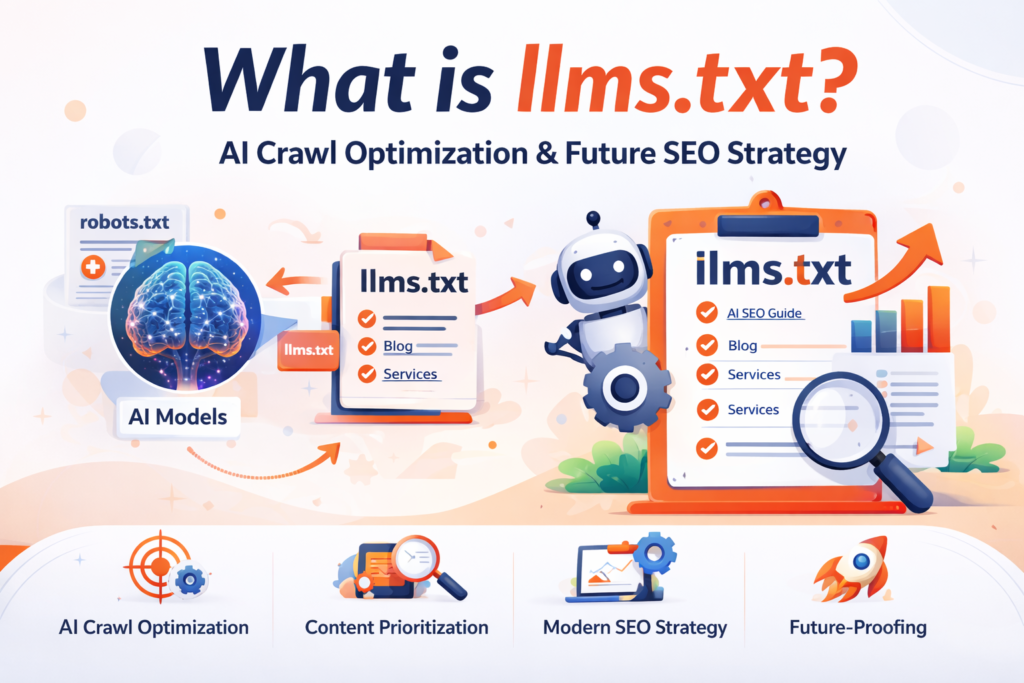
llms.txt is a proposed web standard designed to help large language models (LLMs) better understand and prioritize important content on your website.
It works similarly to robots.txt, but instead of controlling crawler access, it guides AI systems toward key pages and resources. The idea behind llms.txt is simple: provide a structured, easy-to-read file that highlights your most valuable content for AI tools.
The file is typically placed in the root directory of your website:
https://yourdomain.com/llms.txt
Unlike robots.txt, which blocks or allows crawlers, llms.txt does not restrict access. Instead, it acts as a curated roadmap for artificial intelligence systems.
Why llms.txt Matters in the Age of AI Search
Traditional SEO focuses on ranking in search engines like Google or Bing. Search engine bots crawl and index pages and ranking algorithms determine which pages appear in results.
AI systems operate differently.
Large language models don’t just list websites; they analyze, interpret and generate responses based on contextual understanding. This means content must be structured clearly and prioritized effectively.
llms.txt may help:
- Highlight your most authoritative pages
- Guide AI systems to essential content
- Improve clarity for AI-generated summaries
- Reduce misinterpretation of complex information
- Support long-term AI visibility
As AI search continues to evolve, website owners must think beyond rankings and focus on being understood by machines.
llms.txt vs robots.txt: Key Differences
Many people assume llms.txt replaces robots.txt. It does not.
robots.txt
- Controls search engine crawler access
- Can block bots from specific pages
- Impacts indexing behavior
llms.txt
- Does not block access
- Provides guidance for AI systems
- Highlights priority content
Think of robots.txt as a gatekeeper and llms.txt as a content guide.
Both can coexist as part of a modern technical SEO setup.
Does llms.txt Improve SEO Rankings?
One of the most common questions is whether llms.txt directly improves Google rankings.
Currently, there is no confirmed ranking benefit. Major search engines continue to prioritize:
- High-quality content
- User intent alignment
- Page experience
- Structured data
- Internal linking
llms.txt should be seen as a future-focused optimization rather than a direct ranking factor. It complements your SEO efforts but does not replace core best practices.
How to Create an llms.txt File
Implementing llms.txt is relatively simple and requires minimal technical effort.
Step 1: Create the File
Create a text file named:
llms.txt
Step 2: Add Structured Content
Use a clean, Markdown-style format to list priority pages.
Example:
# llms.txt## Core Resourceshttps://yourdomain.com/ai-seo-guide - Complete guide to AI SEO optimization
https://yourdomain.com/services - Overview of digital marketing services
https://yourdomain.com/blog - Educational blog resources
Step 3: Upload to Root Directory
Place the file in your website’s root folder so it can be accessed directly.
What Type of Content Should Be Included?
Not every page needs to be listed.
Focus on:
- High-converting landing pages
- In-depth blog posts
- Educational guides
- Product documentation
- Core service pages
The goal is to help AI systems identify what matters most on your site.
The Role of AI in Modern SEO
AI-powered search tools are influencing how users discover brands, compare services and make decisions.
Instead of browsing multiple websites, users now ask AI tools questions like:
- What is the best SEO strategy for 2026?
- How does AI search optimization work?
- What is llms.txt used for?
These tools generate direct answers using contextual analysis.
This means your content needs to be:
- Clear
- Structured
- Context-rich
- Authoritative
- Well-organized
SEO is no longer just about ranking — it’s about being included in AI-generated responses.
Benefits of Preparing for AI Crawl Optimization
Even if llms.txt adoption is still developing, preparing for AI search has long-term benefits:
- Improved content organization
- Clearer site architecture
- Stronger authority signals
- Enhanced documentation structure
- Better technical SEO foundation
Early adopters of emerging standards often gain competitive advantages.
Limitations and Current Reality
It’s important to remain realistic.
llms.txt is:
- A proposed standard
- Not officially required by search engines
- Not guaranteed to improve rankings
- Still evolving
However, it is also:
- Easy to implement
- Low risk
- Future-ready
As AI continues to reshape digital marketing, structured content and technical clarity will only become more important.
Who Should Consider Implementing llms.txt?
llms.txt is particularly useful for:
- Digital marketing agencies
- SaaS companies
- Educational platforms
- Documentation-heavy websites
- Content-driven businesses
If your website relies on authority, informational content and organic visibility, preparing for AI interpretation makes sense.
Best Practices for Future-Proof SEO
While llms.txt may support AI systems, your core SEO strategy must remain strong.
Focus on:
- Writing helpful, original content
- Matching search intent
- Using proper heading structure
- Improving page speed
- Building internal links
- Adding structured data
- Maintaining mobile responsiveness
AI systems reward clarity and depth. Search engines reward value and user satisfaction. The overlap between these two continues to grow.
The Future of SEO with AI
Search behavior is becoming more conversational. AI summaries, direct answers and contextual recommendations are becoming standard.
As AI tools continue to integrate into search experiences, websites must evolve from keyword-focused optimization to intelligence-focused optimization.
llms.txt represents a step toward structured AI communication. While it may not transform SEO overnight, it signals where the industry is heading.
Conclusion
The digital landscape is shifting toward AI-driven discovery. Users expect instant, accurate answers. Businesses must adapt.
llms.txt is a proposed standard designed to guide large language models toward your most important content. It does not replace traditional SEO, nor does it guarantee ranking improvements. However, it reflects a growing need for structured, AI-friendly content.
If you want to future-proof your SEO strategy in 2026 and beyond, focus on building high-quality content, maintaining strong technical foundations and preparing your website for AI interpretation.
The future of search isn’t just about being found — it’s about being understood.
1. What is llms.txt in simple terms?
llms.txt is a proposed file that helps AI systems understand and find important content on your website more easily.
2. Is llms.txt required for SEO?
No, it is not required currently. Traditional SEO practices still matter more.
3. Does llms.txt replace robots.txt?
No. Robots.txt controls crawler access. llms.txt only guides AI models to important content.
4. Will llms.txt improve Google rankings?
There is no confirmed ranking benefit yet. It is mainly considered a future-focused AI optimization strategy.
5. Should small websites use llms.txt?
Yes, especially if they publish blogs, guides, or educational content and want to stay prepared for AI-based discovery
The future of SEO is evolving beyond traditional search engines.
If you want to prepare your website for AI-driven visibility, now is the time to structure your content smartly.
Start optimizing today — and stay ahead in the AI-powered digital era.