
Table of Contents
Every time you ask ChatGPT a question, get a Google AI Overview, or chat with an AI assistant, you’re really asking one simple question underneath it all: where is this answer coming from? Understanding where AI gets its information isn’t just useful trivia — it matters for anyone who wants to trust AI-generated answers, and it matters even more for brands and marketers who want their content to show up inside those answers.
In this guide, we’ll break down the main sources AI systems rely on, how large language models (LLMs) actually learn, and what you can do to get your own content noticed and cited by AI tools.
Why This Question Matters More Than Ever
AI search is no longer a niche behavior. People are turning to tools like ChatGPT, Perplexity, Gemini, and Google’s AI Overviews as their first stop for research, product comparisons, and quick answers. That shift has created a new discipline often called AI visibility or generative engine optimization (GEO) — the practice of making sure your brand and content get pulled into AI-generated responses, the same way SEO helped brands rank in traditional search results.
But before you can optimize for AI visibility, you need to understand the raw materials AI systems actually work with.
The Four Main Ways AI Systems Get Information
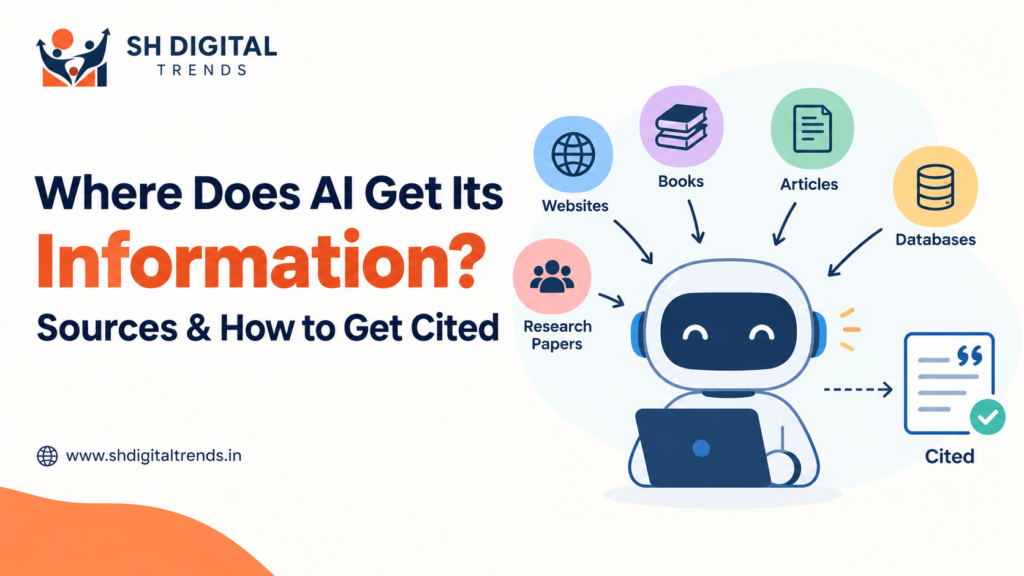
Broadly speaking, AI models gather knowledge through four channels: training data, real-time web retrieval, licensing agreements, and direct user input.
1. Training Data: The Foundational Layer
Every large language model starts with training data — massive datasets of text, code, and other content that teach the model how language works, how facts relate to one another, and how to generate coherent responses. This data typically comes from:
- Publicly available websites, blogs, and news articles
- Open knowledge bases like Wikipedia
- Code repositories such as GitHub
- Books, academic papers, and licensed datasets
- Forums and community discussions
This training process happens in stages, and it’s expensive and time-consuming, which is why every model has a knowledge cutoff date — a point after which it simply hasn’t “seen” any new information unless it’s connected to live tools. This is also why AI models can sound confident about outdated facts if they aren’t paired with real-time search.
2. Real-Time Web Retrieval
Because training data eventually goes stale, most modern AI tools now pair their base model with live retrieval capabilities. When you ask a question about something recent — a stock price, a news event, or a product launch — the AI doesn’t rely purely on memory. Instead, it runs a search, pulls in fresh web pages, and grounds its answer in that live content.
This is exactly how tools like Google’s AI Overviews, Perplexity, and ChatGPT’s browsing mode work. It’s also why fresh, well-structured, and frequently updated content has a real advantage: AI systems tend to favor pages that are current and easy to parse over old, stagnant ones.
3. Licensing Partnerships
Many AI companies have signed formal licensing deals with publishers, news organizations, and platforms to legally use their content for training or citation purposes. These partnerships give AI systems access to higher-quality, vetted information rather than relying solely on whatever is publicly scraped from the open web. If you’ve noticed AI tools frequently citing certain major publications, licensing agreements are often part of the reason why.
4. User-Initiated Actions
The fourth channel is more direct: information the user themselves feeds into the AI. This includes uploaded documents, pasted text, connected apps, or specific instructions to “search this site” or “read this PDF.” In these cases, the AI isn’t relying on training data or the open web at all — it’s working directly from what you hand it in that conversation.
Where AI Actually Pulls Its Answers From: The Data
Recent large-scale research analyzing hundreds of thousands of AI citations across tools like Google AI Mode, Google AI Overviews, ChatGPT, and Perplexity found some surprising patterns. Community-driven platforms — especially Reddit — showed up as a leading source across many AI-generated answers, often ahead of long-standing authorities like Wikipedia and YouTube.
Why would a forum outrank an encyclopedia? A few reasons stand out:
- Real human experience. Community platforms are full of first-hand opinions, reviews, and troubleshooting threads — the kind of nuanced, lived-in detail that’s harder to find in polished corporate copy.
- Built-in quality signals. Upvotes and downvotes act as a crowd-sourced filter, helping AI systems identify which answers within a thread are actually the most useful.
- Conversational structure. Forum threads often directly mirror how people phrase real questions, which maps naturally onto how people prompt AI tools.
The takeaway for brands and content creators: authority alone doesn’t guarantee AI citations anymore. Relevance, freshness, and genuine usefulness carry serious weight.
How to Get Your Content Cited by AI
If you want your brand or website to actually show up inside AI-generated answers, a few practices consistently help:
Write self-contained sections. Structure your content so that each heading and its section can stand alone and fully answer the implied question, without requiring the reader to jump elsewhere on the page for context. AI systems tend to extract chunks of content, not entire articles, so each chunk needs to make sense on its own.
Keep content fresh and updated. AI systems generally favor recently updated pages when there’s live retrieval involved. Revisiting older posts, updating statistics, and refreshing examples can meaningfully improve your odds of being cited.
Build a consistent presence across the web. AI tools don’t just look at your own site — they cross-reference mentions of your brand across third-party sources, review sites, forums, and industry publications. Consistent, accurate information about your brand across multiple sources helps AI systems build (and trust) a coherent picture of who you are.
Earn genuine mentions, not just backlinks. Traditional link-building still matters for SEO, but AI visibility rewards actual brand mentions in context — being referenced naturally in discussions, comparisons, and community threads.
Monitor your AI visibility. Just like tracking keyword rankings in traditional SEO, it’s worth tracking how often (and how accurately) your brand shows up in AI-generated answers. Several SEO platforms now offer AI visibility or AI search tracking tools that show mentions, citations, and sentiment over time.
The Bigger Shift: From SEO to AI Visibility
Traditional SEO was built around a fairly predictable system: crawl, index, rank. AI-generated answers work differently — they synthesize information from multiple sources into a single response, often without a visible list of links. That means the old playbook of “rank #1 and win the click” is evolving into something broader: “become the source AI trusts enough to reference.”
For businesses and content creators, this means treating AI systems almost like a new kind of audience. They need clear, well-organized, up-to-date, and genuinely helpful content — not because it’s a ranking trick, but because that’s precisely the kind of content AI systems are designed to surface.
Final Thoughts
AI doesn’t pull answers out of thin air. It draws from a mix of training data, live web retrieval, licensed content partnerships, and direct user input — with community platforms increasingly playing an outsized role in shaping the answers people see. Understanding this mix is the first step toward both being a smarter consumer of AI-generated information and, if you’re building content, making sure your own expertise has a real shot at being part of the answer.
Where does AI get its information from?
This is the exact head-term query people type into AI tools. It’s broad, high-volume, and the one your existing post already targets directly — keep it as an H1 or H2 verbatim.
How do AI models like ChatGPT source their answers?
Captures searchers who think in terms of specific tools rather than “AI” generically. Answer this in a self-contained paragraph naming the retrieval + training distinction.
What data does ChatGPT use to answer questions?
Tool-specific and very commonly asked. Also picks up long-tail variants (“what does ChatGPT train on,” “does ChatGPT search the internet”).
Why does Reddit show up so often in AI answers?
This is a trending, curiosity-driven question thanks to the Semrush study — timely questions like this get picked up fast by AI Overviews and Perplexity because there’s less competing content answering it well yet.
How can I get my website cited by AI search tools?
This is the actionable/commercial-intent question — the one marketers and business owners actually search before taking action. Answering it well (as you did in the “How to Get Your Content Cited” section) is what drives AI visibility tool signups and backlinks.